
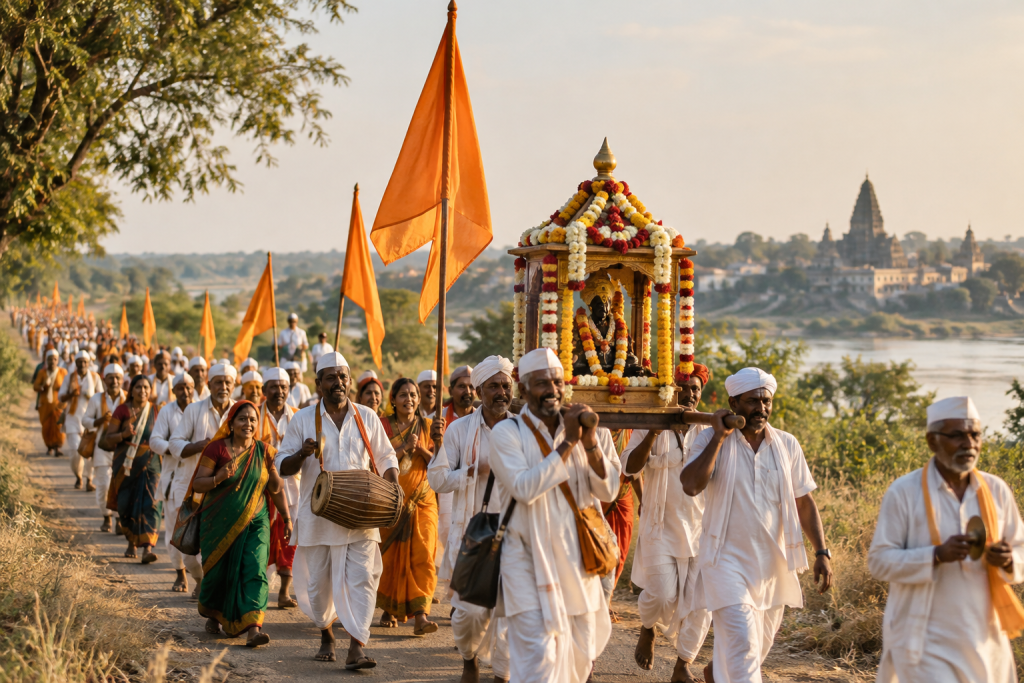
What Is the Wari?
The Wari is one of Maharashtra’s most beloved pilgrimage traditions — a long, on-foot journey that many devotees undertake each year to reach Pandharpur and the Vitthal Rukmini Temple. The word “wari” is closely connected to the idea of an annual pilgrimage, and for countless families this journey is passed down through the generations as a living expression of their faith.
What makes the Wari distinctive is that pilgrims do not simply travel on their own. They walk together in large, orderly groups behind the palanquins, or palkhis, that carry the padukas (sacred footprints) of the great saints associated with the tradition. Each palkhi sets out from its home town and makes its slow, steady way towards Pandharpur, gathering fellow pilgrims along the route.
The Palkhi Tradition
At the heart of the Wari is the palkhi — a beautifully decorated palanquin carried on the shoulders of devotees. The palkhi is treated with great reverence, and the journey is guided by longstanding customs about how it is carried, accompanied and received. As the procession moves through villages, local communities line the roads to welcome the pilgrims, offer them food and water, and join them for a stretch of the way.
For those who take part, the Wari is far more than a long walk. It is a period of simpler living, of singing devotional hymns (abhangs), of service and of companionship. Many pilgrims describe the rhythm of walking, singing and resting together as a deeply peaceful experience that stays with them long after the journey ends.
The Pilgrim Experience
If you have ever watched a Wari procession arrive, you will understand its power. The crowds, the songs and the slow onward movement of thousands of pilgrims all focused on a single destination create a remarkable atmosphere of shared devotion. Even if you do not walk the full journey, you can experience something of this spirit simply by being present in Pandharpur when the processions arrive.
For visitors planning around the Wari season, the most important thing is to expect a very busy town. Roads fill, accommodation becomes scarce, and everything takes longer. This is also when the town is at its most vibrant and meaningful.
Practical Advice for Visitors
- Book accommodation well in advance if you plan to visit during the Wari season, as rooms go quickly.
- Allow extra time for travel; roads leading into Pandharpur can be crowded with processions.
- Expect crowds at the temple and plan your darshan for quieter hours when possible.
- Carry essentials with you, as some conveniences may be harder to reach during the rush.
- Be patient, kind and considerate to the thousands of pilgrims around you.
Dates Vary — Please Verify
The Wari is closely tied to specific religious days, and the exact dates change from year to year according to the traditional calendar. Rather than rely on a fixed schedule, we strongly recommend confirming the current Wari dates and related programmes with official sources or well-established local announcements before you make any travel plans.
Conclusion
The Wari is a powerful expression of Maharashtra’s devotional heritage — a journey of faith shared by thousands of pilgrims as they walk together towards Pandharpur. Whether you join the walk or simply witness its arrival, understanding this tradition will deepen your appreciation of the town you have come to visit.